
Core Education Measures
Forsyth Family Power’s seven core measures align with StriveTogether’s cradle-to-career framework. Together, we track how well our systems serve every student — and take action where they don’t.
Kindergarten Readiness
The years before Kindergarten are critical for the healthy development of a child’s mind, body, and capacity to learn later in life. Many children enter Kindergarten without the skills necessary to excel in reading and are at risk of falling behind their peers. The data used in this measure is the Dynamic Indicators of Basic Early Literacy Skills (DIBELS) Beginning of Year (BOY) assessment. DIBELS benchmark scores indicate a student’s reading progress compared to a goal that predicts future success. Scores are categorized as above benchmark (low risk), at benchmark (on track), strategic (some risk), or below benchmark (at-risk). View data notes for this measure.
Data Visualization
Kindergarteners At Benchmark or Above on BOY DIBELS (2017-25 School Year)
Use the dropdown menu below to view data on different groups.

Key Takeaways
The majority of Kindergarten students were not at Benchmark.
Only 33% of Kindergarten students were at Benchmark or above on the beginning of year DIBELS reading assessment.
Disparities were present in Benchmark levels by race/ethnicity.
Black and Hispanic/Latino Kindergarten students had lower Benchmark levels in the beginning of year DIBELS assessment compared to their White peers.
Data Notes
Kindergarteners Benchmark on BOY DIBELS
The year on the graph is the year the school year ends. Data is not included for the school years that ended in 2020 and 2021 because of the pandemic.
Data source: Winston-Salem/Forsyth County Schools
Third Grade Reading
Children who are unequipped with basic reading skills at the end of third grade are at much greater risk of falling behind in school. After third grade, instruction transitions from “learning to read” to “reading to learn.” This measure is based on the reading test taken at the end of third grade; proficiency on this test is defined as possessing the skills required to read at a third grade level. View data notes for this measure.
Data Visualization
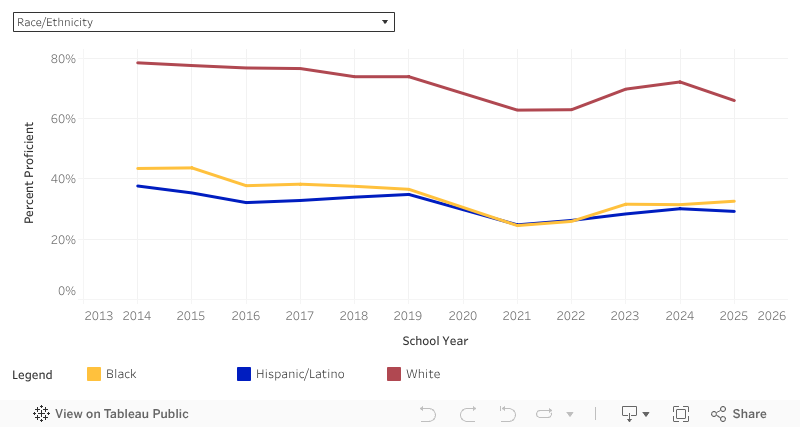
Grade-level Proficiency on End of Grade Third Grade Reading Test (2014-25 School Years)
Use the dropdown menu below to view data on different groups.
Key Takeaways
School Year 2020-21
Proficiency rates have been about the same for the last three school years.
In the 2024-2025 school year, 44% of students were proficient.
Disparities by race/ethnicity and economic status were present for the 2024-2025 school year.
For the 2024-2025 school year third grade end of grade reading test, Black students were proficient at 33% and Hispanic/Latino students both were proficient at 29% compared to 66% of White students. And 32% of economically disadvantaged students were proficient compared to 62% of not economically disadvantaged students.
Data Notes
Grade-level Proficiency on End of Grade Third Grade Reading Test
The year on the graph is the year the school year ends. Economic disadvantage is defined as students who are receiving free- or reduced-price lunch. Data from the 2019-20 school year is not included because end of grade testing did not take place.
Data source: North Carolina Department of Public Instruction
Eighth Grade Math
Math is a critical way to measure and understand the world with greater precision. Many careers in the modern economy require a strong foundation in math. Math skills in eighth grade are a predictor of success in post-secondary education. Most eighth grade students take the eighth grade math EOG test or the Math I test (eighth grade students who are advanced in math). The measure used here is the percent of eighth grade students who were proficient on whichever of those two tests that the student took at the end of their eighth grade year. Proficiency on these tests is defined as the skills required to do math at grade level. View data notes for this measure. View data notes for this measure.
Data Visualization
Grade-level Proficiency of Eighth Grade Students on End of Grade Eighth Grade Math/Math I Tests (2019-25 School Years)
Use the dropdown menu below to view data on different groups.

Key Takeaways
School Year 2020-21
Proficiency rates have been increasing since the pandemic.
In the 2024-2025 school year, 39% of students were proficient compared to 24% in the 2020-2021 school year.
Disparities by race/ethnicity and economic status were present for the 2024-2025 school year.
For the 2024-2025 school year, Black and Hispanic/Latino students were proficient at 22% and 26%, respectively, compared to 65% of White students and 25% of economically disadvantaged students compared to 57% of not economically disadvantaged students.
Data Notes
Grade-level Proficiency on End of Grade Eighth Grade Math Test
The year on the graph is the year the school year ends. Economic disadvantage is defined as students who are receiving free- or reduced-price lunch. Data from the 2019-20 school year is not included because end of grade testing did not take place.
Data source: North Carolina Department of Public Instruction
High School Graduation
In today’s economy, people with a high school diploma have better employment prospects. Increasingly, a person who lacks a high school diploma is more likely to live in poverty, suffer from poor health, and engage in crime. The measure used for High School Graduation is the four-year graduation rate, which is considered to be on-time graduation for high school students. View data notes for this measure.
Data Visualization
Four-Year High School Graduation Rate (2013-2025 School Years)
Use the dropdown menu below to view data on different groups.

Key Takeaways
School Year 2020-21
The high school graduation rate has remained relatively consistent the last few years.
Disparities were present in four-year graduation rates by student economic status.
Fewer economically disadvantaged students graduated on time (82%) compared to their non-economically disadvantaged peers (90%).
Disparities were present in four-year graduation rates by gender.
Fewer male students graduated on-time (84%) compared to female students (88%).
Disparities were present in four-year graduation rates by race/ethnicity.
Slightly fewer Black students than White students graduated in four years, 87% compared to 89%. Fewer Hispanic/Latino students graduated in four years (82%) compared to their Black and White peers.
Data Notes
Four-Year High School Graduation Rate
Economic disadvantage is defined as students who are receiving free- or reduced-price lunch.
Data source: North Carolina Department of Public Instruction
College Enrollment
Many high school graduates do not take this critical first step toward post-secondary educational attainment. This measure represents the percentage of high school graduates who enroll in college during the fall after graduation. The school year included in the data visualization is the year of high school graduation. View data notes for this measure.
Data Visualization
College Enrollment in the Fall After High School Graduation (Graduates from 2013 – 2020)
Use the dropdown menu below to view data on different groups.

Key Takeaways
School Year 2020-21
Updated data coming in December, 2025.
Data Notes
College Enrollment in the Fall After High School Graduation
Economic disadvantage is defined as students who are receiving free or reduced price lunch.
Data source: National Student Clearinghouse
College Completion
Post-secondary education, attained after high school, plays a key role in upward mobility. This includes colleges, community colleges, and universities, among others. This measure reflects the percentage of Winston-Salem/Forsyth County Schools high school graduates who complete a degree (Bachelor’s or Associates) within six years of high school graduation. The year in the graph represents the year of high school graduation. View data notes for this measure.
Data Visualization
Six-Year College Completion (Graduates from 2012-15)
Use the dropdown menu below to view data on different groups.

Key Takeaways
School Year 2020-21
Updated data coming in December, 2025.
Data Notes
Six-Year College Completion
Economic disadvantage is defined as students who are receiving free- or reduced-price lunch. Race/ethnicity and economic status disaggregation is not available for the high school class of 2012.
Data source: National Student Clearinghouse