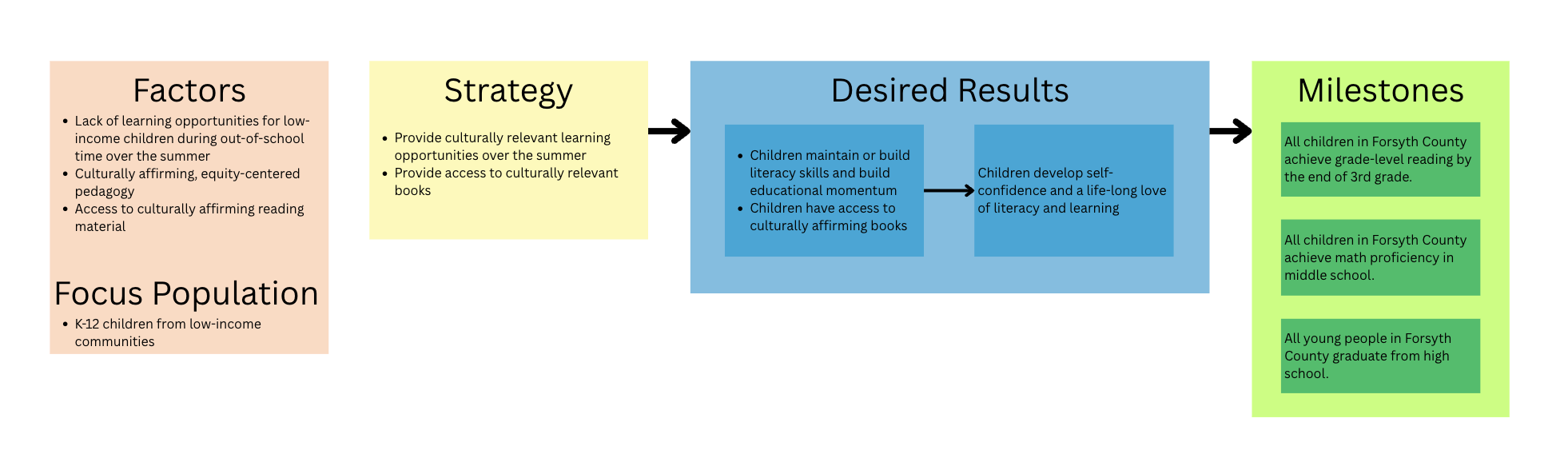
Develop a life-long love of reading and learning by providing culturally relevant summer learning opportunities and reading materials for children
This strategy contributes to the Early Grade Reading, Middle Grade Math, and High School Graduation Whole Child Milestones.
A strategy is a set of actions that work together to create change.
Who is this strategy designed to support?
K-12 children from low-income communities.
How does this strategy help move children and youth to economic mobility?
- All children in Forsyth County achieve grade-level reading by the end of 3rd grade.
- All children in Forsyth County achieve math proficiency in middle school.
- All young people in Forsyth County graduate from high school.
What is this strategy trying to change or improve?
- Lack of learning opportunities for low-income children during out-of-school time over the summer
- Culturally affirming, equity-centered pedagogy
- Access to culturally affirming reading material
How does this strategy create change?
Strategy diagrams show how strategies lead to better outcomes—from the actions we take today to the long-term changes we hope to see.
Where did this strategy come from?
Information on where this strategy came from is coming soon.
Who has committed to partnering in this work?
Winston-Salem Freedom Schools
How will we know if this strategy is working?
Number of children attending Freedom Schools.
Using site attendance records, report how many children attended Freedom Schools across the county, for how many days of the program, disaggregated by grade level, socioeconomic information, race/ethnicity, and gender.
Goal: 400+ children attending during the summer 2026 program
Fidelity of implementation of culturally relevant, equity-centered curriculum.
Rubric-based observations of teachers providing instruction, interacting with children, and of teachers’ classroom/learning environments, with respect to cultural relevance/responsiveness and equity.
Goal: 100% of teachers demonstrate strong fidelity of implementation of curriculum each year.
Number of books distributed to children.
Using book distribution data tracked for each site and reported to CDF, report the average number of books distributed per child per program year.
Goal: 11.6 books distributed per child during the summer 2026 program
Summer learning loss prevention.
Pre- and post-tests using the Basic Reading Inventory (11th Ed.) administered to all enrolled children. Results are tracked by grade level and disaggregated by demographics.
Goal: 85% of children maintain or improve their instructional reading levels during the 2026 summer program.
Summer Literacy Enrichment
Comparison of Freedom School children to demographically matched group of peers in terms of literacy proficiency.
Goal: Freedom School children are statistically significantly higher on measure of literacy proficiency at beginning of school compared to peers, each year.
Children’s Self-Confidence
Survey of children’s self-confidence (possibly added to the survey of SEL competencies conducted as part of the CDF Freedom Schools National Assessment, if that is recurring)
Goal: 100% of children report high levels of self-confidence each year
Percent/Number of 3rd graders each year who participated in Freedom Schools with proficient and college-ready reading scores compared to the percentage of peers from similar backgrounds.
Percent/Number of 8th graders each year who participated in Freedom Schools with proficient and college-ready math scores compared to the percentage of peers from similar backgrounds.
Percent/Number of students each year who participated in Freedom Schools graduating from high school in 4 years compared to the percentage of peers from similar backgrounds.
How can I support this strategy?
Information on how you can support this strategy is coming soon.