Early Grade Reading
Children who are unequipped with basic reading skills at the end of third grade are at much greater risk of falling behind in school. After third grade, instruction transitions from “learning to read” to “reading to learn.” This measure is based on the reading test taken at the end of third grade; proficiency on this test is defined as possessing the skills required to read at a third grade level. View data notes for this measure.
Data Visualization
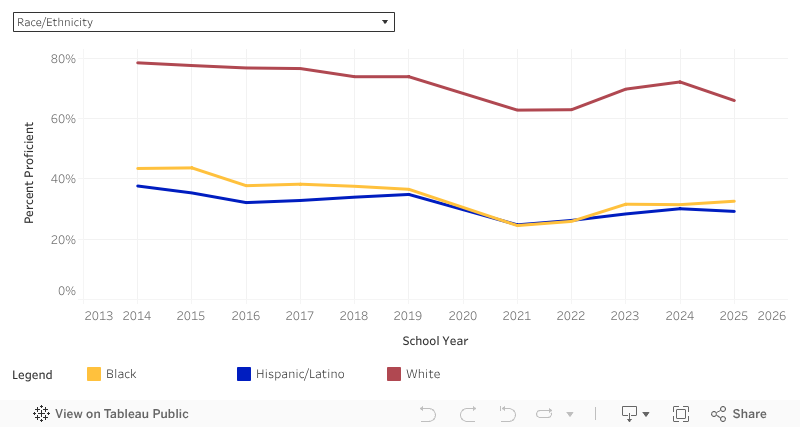
Grade-level Proficiency on End of Grade Third Grade Reading Test (2014-25 School Years)
Use the dropdown menu below to view data on different groups.
Key Takeaways
School Year 2020-21
Proficiency rates have been about the same for the last three school years.
In the 2024-2025 school year, 44% of students were proficient.
Disparities by race/ethnicity and economic status were present for the 2024-2025 school year.
For the 2024-2025 school year third grade end of grade reading test, Black students were proficient at 33% and Hispanic/Latino students both were proficient at 29% compared to 66% of White students. And 32% of economically disadvantaged students were proficient compared to 62% of not economically disadvantaged students.
Working together to improve Early Grade Reading
Across Forsyth County, individuals, organizations, community groups, networks, and public institutions are working to ensure every child can read on grade level.
The strategies below represent the many ways our community is working toward that shared goal. By making these efforts visible, we can better understand how our work fits together, identify opportunities for collaboration, and strengthen our collective impact.
Align partners around a shared vision, data-driven decision making, coordinated action, and collective accountability, using work groups to implement substrategies addressing: teacher training and recruitment, and messaging and fundraising to support literacy
GLR-01
Improve equitable access to literacy supports by identifying community gaps, aligning resources, increasing family and community awareness of literacy resources, and strengthening family engagement with coordinated supports where they are most needed. Current sub-strategies include coordination around: Early childhood care, book access, and out-of-school time services
GLR-02
Train a diverse cohort of local residents as teachers in pedagogical best practices
WST-01
Develop a life-long love of reading and learning by providing culturally relevant summer learning opportunities and reading materials for children
FRS-01
Build community power and lasting family leadership infrastructure within schools by holding regular Freedom Family Tables
FRS-02
Build capacity of educators and future educators to effectively deliver culturally relevant curriculum
FRS-03
Facilitate network connection & collaboration among providers of youth extracurricular services to align programming, build capacity around best practices, and increase access
HTC-01
Collaboratively design and implement youth programming events that promote protective factors for youth
HTC-02
Raise awareness of and increase community support for youth well-being needs through public demonstrations, publications, and events.
HTC-03
Work collaboratively with partners to identify gaps and identify resources for youth mental health supports
MBK-01
Transform the policies, practices, and resource flows that influence how schools, law enforcement, and community institutions respond to student behavior.
SJP-01
Build capacity and strengthen collaboration, trust, and shared ownership among the school system, law enforcement, juvenile justice, community organizations, and families, to create coordinated responses that better support students.
SJP-02
Shift the beliefs, expectations, and cultural norms surrounding school discipline held by individuals within the organizations serving students in Forsyth County.
SJP-03
Data Notes
Grade-level Proficiency on End of Grade Third Grade Reading Test
The year on the graph is the year the school year ends. Economic disadvantage is defined as students who are receiving free- or reduced-price lunch. Data from the 2019-20 school year is not included because end of grade testing did not take place.
Data source: North Carolina Department of Public Instruction